


If you’re looking for a challenge, try making a movie featuring animals.
We’re not talking about anthropomorphic talking animals like Babe or those live-action Lion King movies. I mean, real, unbridled animals in front of a camera just being themselves and crapping all over the place.
Long before CGI became the norm in every Hollywood film, real animals were often used, with the aid of handlers, in all their real-life glory. It’s not seen as much today for various reasons.
For starters, Hollywood’s troubling history of animal mistreatment eventually brought direct oversight from the American Humane Society and the now-familiar statement, “No animals were harmed in the making of this film.”
The notorious and much-reappraised Western epic Heaven’s Gate (1980) played a major role in this shift, after facing serious accusations of animal abuse, including horses killed during battle scenes, cows slaughtered for stage blood, and even staged cockfights.
It’s safer and cheaper to make animals CGI nowadays. As a result, modern films have lost yet another element of realism to green screens and computer-generated effects. What careful balance can be employed?
Movie Mania
One technique for preserving realism was seamlessly blending live animals with practical effects, ensuring the suspension of disbelief remained intact.
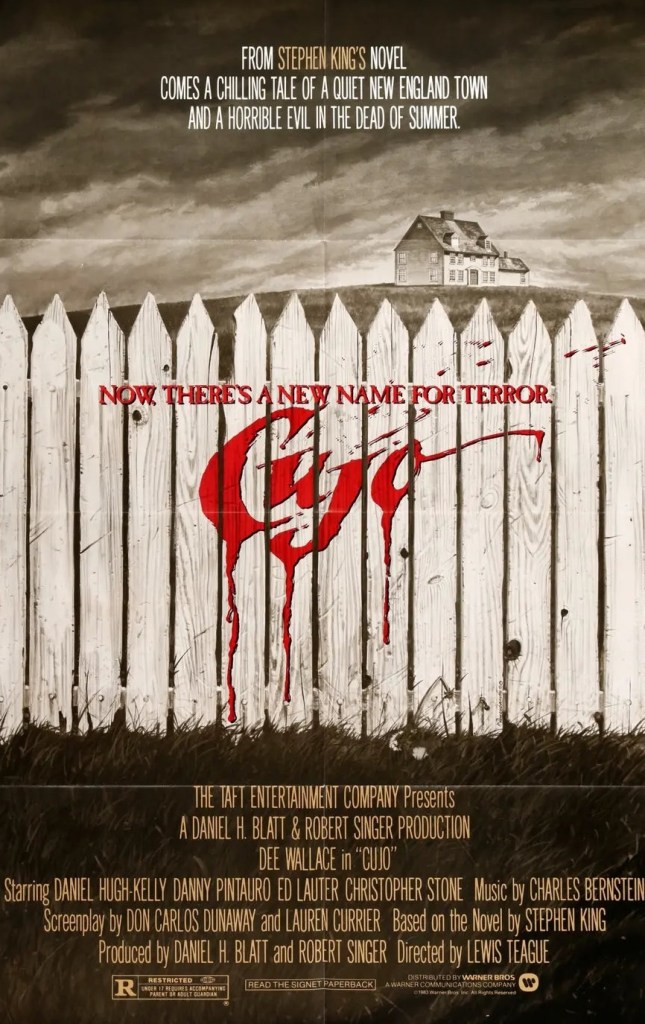
For instance, the 1983 adaptation of Stephen King’s Cujo featured a real St. Bernard, a puppet, and an actor in a dog costume. It’s not a great movie, but it does the job. There’s little doubt that if it were made today, the dog would be almost entirely CGI.
Practical effects are often costly and cumbersome, demanding more time, effort, and money than most studios are willing to invest. The result is often bland and filled with artificial substitutes. Computer-generated effects, no matter how advanced, rarely match the authenticity of the real thing.

The Bear (a movie from 1988 and not the TV show about a chef) centered around an orphaned grizzly cub’s journey to survive. It was mainly shot from the perspective of an animal, and there hasn’t been anything quite like it since.
Bart the Bear appeared in the film as a full-sized grizzly, along with notable appearances in White Fang (1991), Legends of the Fall (1994), and The Edge (1997).
The 1981 cult film Roar infamously used real lions and tigers in scenes set on a family ranch. Director Noel Marshall placed his own family—including wife Tippi Hedren and stepdaughter Melanie Griffith—along with other actors in extreme danger, resulting in numerous attacks and serious injuries from the untrained animals.

The Adventures of Milo and Otis (1986) was a seemingly adorable film from my childhood that featured a tabby cat named Milo and his pug friend Otis. I later discovered that it was originally a Japanese film, one plagued by multiple animal welfare allegations—something made disturbingly clear by the very real danger the animals are placed in on screen
Rumors persisted of multiple cats and/or pugs injured or killed during production with no oversight for their welfare. No official accounts exist, but it’s enough to ruin one’s childhood.
I never heard of anything like that happening during Homeward Bound: The Incredible Journey (1993), featuring all real animals. The production reportedly took great strides to ensure no harm came to its animal actors. How about that?
The horror anthology classic Creepshow (1982) featured a scene with thousands of real cockroaches bursting from the insides of a germophobic man.
Several years later, Arachnophobia (1990) blended hundreds of real spiders with mechanical ones to maximize its impact. Films like these would certainly rely on CGI if made today. And they wouldn’t be nearly as interesting.
Special F/X
I realize that most of the films referenced so far were from the 1980s. It so happens that practical effects of the ‘80s reached new heights with all the talent involved.
Rick Baker, Sam Winston, Tom Savini, Rob Bottin, and many others lent their innovative genius to films like An American Werewolf in London, The Howling, The Terminator, The Fly, Predator, Aliens, Robocop, Ghostbusters, and Gremlins, to name a few. We’ll never see special effects artists of this caliber in our lifetime again.
Ghost and the Darkness (1996), starring Michael Douglas and Val Kilmer, was a movie about a late-nineteenth-century Kenyan railway project besieged by killer lions.
The use of CGI was gradually becoming more commonplace by the mid-nineties, propelled by the landmark effects of Jurassic Park (1993). Ghost and the Darkness effectively blended real lions with computer-generated ones. Nowadays, CGI dominates every frame.
Val Kilmer’s death from pneumonia at 65 after years of battling throat cancer was a shock. Like so many, I grew up with his films. He was an excellent actor.
We’ve also recently lost Gene Hackman, Michael Madsen, George Wendt, Joe Don Baker, Terence Stamp, among others. They can’t (and shouldn’t) be brought back through CGI holograms, digital likenesses, AI, black magic, or voodoo. Their work alone has immortalized them.
We’re living in a different age; maybe one we weren’t prepared for, but we’ve got to push on, nonetheless. What other choice do we have?
 Shawn McKee
Leave a comment